L3Harris Technologies will design, assemble and integrate a new test telescope for NASA’s contribution to LISA, the planned space observatory for detecting gravitational waves. NASA described the next development step in an October 8 report.
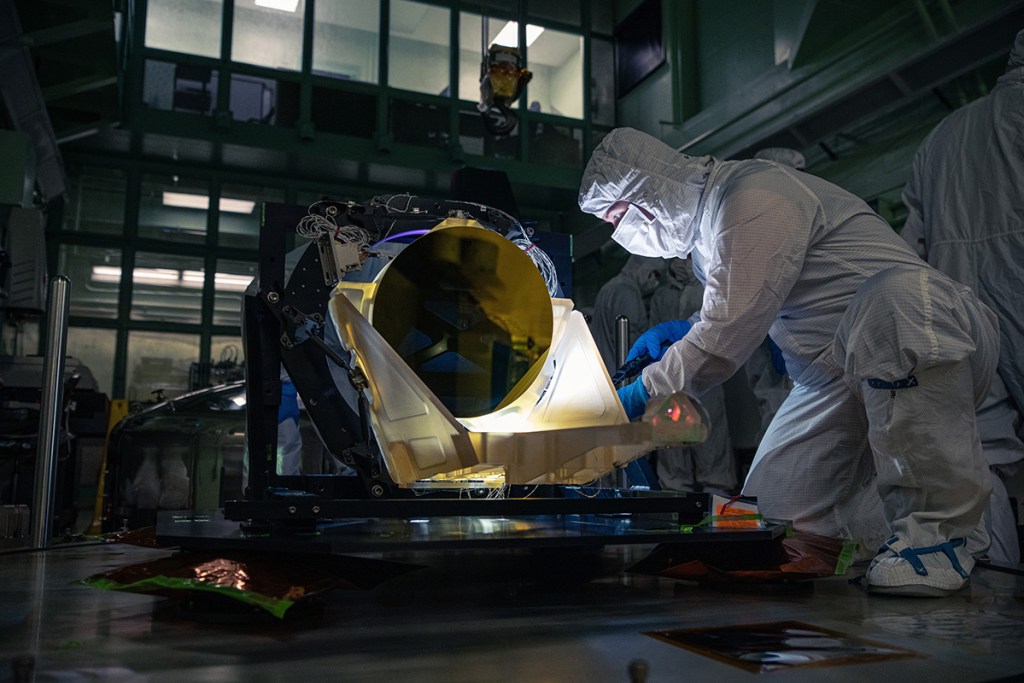
Called the Engineering Test Unit, the telescope will follow a prototype L3Harris delivered to NASA in May 2024. Telescope program lead Ritva Keski-Kuha said testing of that prototype will inform the new unit. She described it as NASA’s last pre-flight unit and its first planned optical telescope delivery to the European Space Agency.
The team delivered a separate metal structural model in June 2026. The new telescope will use Zerodur, an amber-colored glass-ceramic composite that resists changing shape across a wide range of temperatures.
LISA, short for Laser Interferometer Space Antenna, is led by the European Space Agency and slated to launch in the mid-2030s. NASA is contributing telescopes, other hardware and scientific and engineering support.
The mission’s three spacecraft will form a triangle with sides about 1.6 million miles long. Each spacecraft will carry two telescopes to send and receive infrared laser signals. Those signals will be used to measure tiny changes in the distances between spacecraft as gravitational waves — ripples in space-time — pass through.
NASA project scientist Ira Thorpe said LISA is expected to detect low-frequency gravitational waves beyond the reach of current ground facilities, including signals from mergers of massive black holes.